
Does Clay Matthews' Productivity Change Throughout the Season?

By MikeReuter
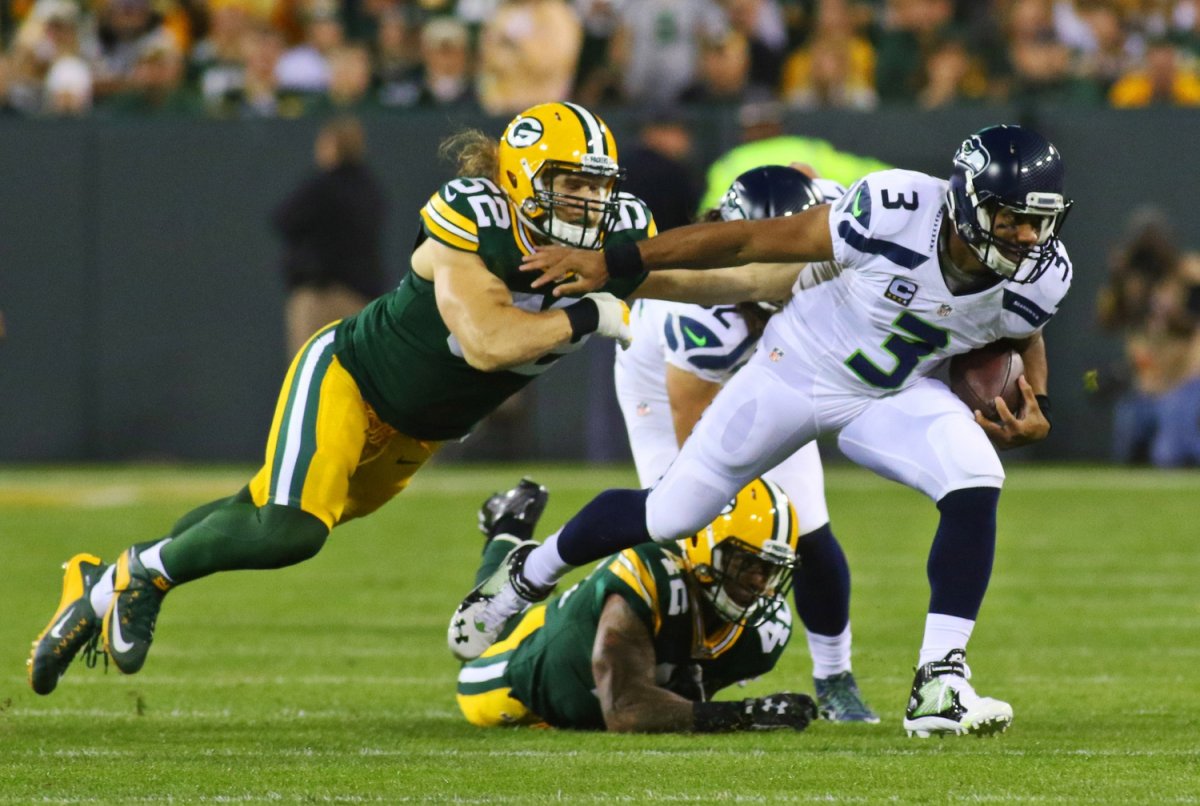
Clay Matthews is the linchpin for the Packers defense and has been since the day he was drafted in 2009. For Clay's first five seasons in the NFL he was the pass rush for the Green Bay Packers. If Clay didn't play well, odds are the defense didn't either. Last season, largely due to the addition of Julius Peppers and the improvement of Mike Daniels, the Packers were able to move Clay to inside linebacker halfway though the season for portions of games in an effort to improve the run defense. This move was to help the defense as a whole and when they needed a pass rush, they could still let Matthews do that from different areas on the field. That facet of his game was not abandoned and in fact was still heavily relied on.
Not only did that move to inside linebacker directly help the team's performance on the field, it indirectly helped the defense by potentially allowing Matthews to avoid soft-tissue injuries that he seems to suffer so often in his career. When Clay gets a hamstring injury, it seems to linger for the majority of the season because he never slows down.
When I think of Matthews' production throughout the season, I think of a player who is shot out of a cannon to start the season. He brings pressure on seemingly every play and takes over games. Now maybe it is just me, but that's how I've always thought of him. As the season goes on, either through general fatigue or because of injuries, I seem to think that Clay's production drops as well. I'm not sure how many others feel that way or not, but the reason I wrote this piece is because I wanted to take a look at Clay Matthews' production throughout the season to see if that production dip is indeed a thing.
To start, I think it is necessary to look at his playing time over the season. Both in terms of games played and percent of snaps played. For this piece I have broken NFL seasons into five sections: season games 1-4, 5-8, 9-12, 13-16, and the playoffs with each segment summed together over his career.
| Percent of Games Played for Various Season Segments | |
| Segment | Percent of Games Played |
| Games 1 through 4 | 100% |
| Games 5 through 8 | 79.2% |
| Games 9 through 12 | 87.5% |
| Games 13 through 16 | 87.5% |
| Playoffs | 90.9% |
It is interesting to me that Clay has played in every game in the first four games of the season throughout his career. He hasn't missed a single one. That surprised me quite a bit actually. However the block of games right after that, games five through eight in the season, Clay played the fewest percent of games than any other block in his career. Each segment of games after five through eight saw him playing in higher and higher percentage of games once the Packers hit the second half of the season.
It would seem that the Packers played him a lot early in the season, when he may have already been injured from camp or the preseason, and he eventually got a little too injured and had to miss a game or two in games five through eight of the season. Then after that he would come back healthy and start playing more as the season goes on.
Looking at the percent of snaps played for games that Matthews was in, makes his playing time even more interesting.
| Percent of Snaps Played for Games Matthews Was in during Various Season Segments | |
| Segment | Percent of Snaps Played |
| Games 1 through 4 | 80.4% |
| Games 5 through 8 | 83.5% |
| Games 9 through 12 | 91.4% |
| Games 13 through 16 | 92.9% |
| Playoffs | 97.2% |
While Matthews may have played in every game of the first four games of each season in his career, he only played in 80 percent of the snaps for those games, the lowest four game segment for his career. In fact, as the season goes on, Matthews plays in more and more snaps each game.
This kind of surprised me, I expected him to be playing in almost all of the snaps to start the season, and for pretty much all games actually. I didn't really think there would be a change in snap percentage. Clay playing in 97 percent of snaps in the playoffs is no surprise, they need him in there and the playing time percentage going up at the end of the regular season for him makes sense for the same reason - they cannot afford for him to not be in there.
Does his playing time relate to his production though?
| Clay Matthews Per Game Production by Season Game Segment | ||||
| Game Segment | Sacks | Hits | Hurries | Total Disruptions |
| 1 through 4 | 0.85 | 0.74 | 2.30 | 3.89 |
| 5 though 8 | 0.58 | 1.11 | 1.95 | 3.63 |
| 9 though 12 | 0.62 | 0.81 | 2.43 | 3.86 |
| 13 though 16 | 0.86 | 0.71 | 1.48 | 3.05 |
| Playoffs | 0.90 | 0.60 | 1.70 | 3.20 |
There's two things I take away from the table above. The first is that the higher the percentage of games that Matthews plays, the more likely he is to put up more sacks per game. This is likely due to opportunity, because Matthews thrives on the big games where he absolutely dominates. Obviously the more big games he has, the higher his sacks per game are going to be.
The other thing that stands out to me is just how much more effective Clay Matthews is at the start of the season than he is at the end of the season. Games 13 through 16 and the playoffs are by far the least productive for Matthews if you go by total disruptions. This seems to match what I was thinking in my head, which is nice to know I wasn't making that up.
Clay Matthews' current role with the Packers is not the same as what these tables represent. He is no longer called upon to be the pass rushing force he once was. The Packers are relying on Peppers, Daniels, Neal, Elliott, and hopefully Datone Jones to create the pressures and moving Matthews to help out where ever they need the help. Whether that be as a run stopper, pass rusher, or in pass coverage.
So far Matthews has played in all three games of the season, just like he has at this point in every season of his career. The real test will come once he gets into week five and beyond to see how he is fairing. Thus far he has only missed four snaps all season, good for 98 percent of the defense's snaps, way above the 80 percent he has averaged for the first four games of a season in his career. His playing time is way up and despite his different role, his pass rush productivity is still up, like it always is at this point in the season. He is averaging 3.7 QB disruptions so far even though he has played, by far, the most coverage snaps he ever has to start a season. Clay Matthews is still in the top three for the Packers' defense in QB sacks, QB hurries, and QB hits on the season, quite impressive.
Matthews has surprisingly turned into the versatile player that Capers depended on Charles Woodson being for his last few years in Green Bay. Like Woodson, Matthews will need to make plays in every area of the game for the defense to be successful.
By putting him in this role, hopefully this allows Clay's production to continue throughout the entire season and not drop off at the end like it has before. This year he has arguably been as productive as he has ever been. With this new role he (theoretically) will not be putting up the same kind of numbers he was before, but make no mistake, his impact will be bigger than previous seasons and him being 100% and energized is as important as ever.








Comments (3)
DrealynWilliams
October 01, 2015 at 02:38 pm
It sucks to be human...
EddieLee
October 01, 2015 at 06:40 pm
Did you include his stats for his rookie season in the data set? He didn't start that year until week 8 and thus played a very limited amount of snaps and had a very limited injury risk. It would probably be more statistically relevant to not include his rookie year given his role the first half of that year. It's just an outlier year that may skew the overall data.
All that being said, I tend to agree with your point that Clay becomes less effective as the season goes on. He starts out like a Tasmanian devil and it seems to ramp down during the season before it ramps back up in big games at the end of the year. I am guessing that is normal for players of his intensity and elite status. You just can't keep it that amped up for 16-20 games. I also thought he was the least amount disruptive of his entire career last year in games 3 through 7 BEFORE being switched to ILB. I thought he was a bunch more disruptive on many more plays at ILB then OLB last year. In my opinion, it is just harder for OC's to scheme around him at ILB then OLB.
Lastly, this may also show the importance of sitting Matthews when possible. When up on a team they need to step on their neck so Matthews and Rodgers can stay on the sideline for the 4th quarter.
Thegreatreynoldo
October 01, 2015 at 08:21 pm
This is a nice article. Agree that perhaps CM3's rookie year should be excluded. I would guess that all players wear down over a 16 game year. It would surprise me if every player didn't have reduced output later in the year. How different is CM3's curve from Peppers' or Daniels'?
His playoff stats should be lower than the rest of the regular season. By definition, he is facing more skilled players in the playoffs than on average during the regular season, probably better coaching and possibly teams that have 2 weeks to scheme in some cases.